The Teeter FreeStep Recumbent Cross Trainer is aimed at buyers who want a low-impact cardio machine that still works both the upper and lower body.
If your priority is joint-friendly movement, seated comfort, and a controlled workout, this one has a clear identity.
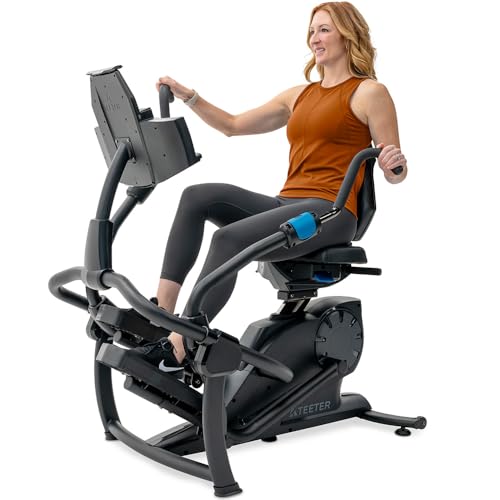
FreeStep Review Summary
The Teeter FreeStep makes sense for buyers who are tired of cardio equipment that feels harsh on the knees, hips, or back.
Its strongest appeal is the combination of a seated position, a natural stepping motion, and dual power movement that spreads the work across more muscle groups than a standard recumbent bike.
It is especially well matched to home users looking for a gentler training option, people comparing cardio machines for joint comfort, and anyone who wants one machine to support both lower-body and upper-body work.
The tradeoff is that this is a specialized machine, not a minimalist fitness buy.
You are paying for comfort engineering, range of motion, and features that support longer-term use.
Review Scorecard
| Category | Score | Rationale |
|---|---|---|
| Joint Comfort | 10/10 | Built around zero-impact movement and a seated position meant to reduce stress on knees and back. |
| Full-Body Training | 9/10 | Dual power motion engages upper and lower body at the same time. |
| Home Workout Convenience | 9/10 | Quiet synchronized motion, transport wheels, cup holders, and a media rack support routine use. |
| Ease of Use | 8/10 | Electronic step lock and adjustable setup details help entry, exit, and positioning. |
| Training Variety | 8/10 | 20 resistance levels and 21 preset workouts give it more structure than a bare-bones cardio machine. |
| Comfort and Fit | 9/10 | Extra-large seat, adjustable media rack, and wide user height range support a broad set of users. |
| Value for the Right Buyer | 8/10 | Strong feature set for buyers who specifically need low-impact cardio, but less compelling if you only want basic pedaling. |
Key Features and Specifications of FreeStep
The main idea behind the FreeStep is simple: deliver cardio that feels easier on the body without making the workout feel trivial.
Teeter positions it as a zero-impact exercise machine with a patented natural stride licensed from commercial physiotherapy steppers.
The brand also says the motion is designed to be easier on knees and back than typical recumbent bikes or cross trainers with a cycle motion.
- Brand: Teeter
- Product type: Recumbent cross trainer / stepper
- Workout style: Seated, dual power motion for upper and lower body
- Resistance: 20 levels of magnetic resistance
- Console: 9-inch color LCD with 7 tracking metrics
- Programs: 21 pre-programmed, goal-based workouts
- Connectivity: Bluetooth heart-rate compatible
- App support: Teeter Move training app, subscription free, iOS and Android compatible
- Comfort features: Extra-large ComfortMax seat, SoftStep pedals, SureGrip handles
- Convenience features: Electronic step lock, dual cup holders, transport wheels, media rack with USB charging
- User support: Rated for users 4 ft 11 in to 6 ft 6 in and up to 350 lb
That spec list tells you who the machine is for.
This is not trying to be an ultra-compact pedal unit or a pure lower-body trainer.
It is a more substantial home cardio machine built around comfort, stability, and repeatable sessions.
The seat and posture matter a lot here.
A recumbent setup lowers the demand on balance and can make it easier to stick with workouts when standing cardio feels punishing.
The dual-action design is also important because it lets the arms contribute, which may help the workout feel more balanced and less repetitive.
Pros and Cons of FreeStep
Pros
- Very low-impact design for users worried about joint stress.
- Full-body motion can make cardio feel more efficient than a leg-only machine.
- 20 resistance levels give it room to grow with the user.
- Preset workouts add structure for people who do better with guidance.
- Comfort-focused details like the large seat, step lock, and media rack improve routine use.
- Broad fit range makes it easier to recommend to different household members.
Cons
- Not a minimalist machine; it needs more space and commitment than a basic under-desk or compact pedal option.
- Specialized use case means it makes less sense if you only want simple cycling.
- Feature density may be overkill for casual users who do not plan to use the programs, resistance range, or app.
- Assembly and setup are likely more involved than with simpler cardio gear, even with the BILT app support.
The biggest takeaway is that the FreeStep’s advantages are tied to its design purpose.
If you want easy movement, seated stability, and a more forgiving cardio experience, the pros are meaningful.
If you only want the cheapest or smallest way to move, the machine is probably more than you need.
Who Should Buy FreeStep?
The FreeStep fits best if you want a home cardio machine that encourages consistency by reducing discomfort.
It is a strong candidate for buyers who want exercise options that are easier on the knees and back, especially when traditional cardio machines feel too aggressive.
It is also a practical pick for users who want more than passive pedaling.
The arm-and-leg motion gives the workout more of a total-body feel, and the resistance levels plus preset programs make it easier to build a routine instead of improvising every session.
This is a smart fit for:
- Buyers looking for joint-friendly cardio
- People who prefer seated exercise
- Home users who want upper- and lower-body engagement
- Anyone who likes guided workouts and adjustable resistance
- Households where different users need a machine with a wide fit range
It is less compelling for:
- Buyers who only want a small, simple, compact cardio device
- Users who already prefer upright cycling or walking-style cardio
- Shoppers who do not need the extra comfort and training features
How the FreeStep Stacks Up in Daily Use
Joint-Friendly Motion
The main reason to buy the FreeStep is the motion itself.
Teeter’s listing emphasizes a natural stride and zero-impact exercise, and that matters more than any one console feature.
For buyers managing sensitive knees, backs, hips, or ankles, the value proposition is clear: the workout is built to feel less punishing while still raising your heart rate.
Full-Body Effort Without Standing
Dual power motion is the feature that separates this machine from a basic recumbent bike.
Because both the handles and pedals contribute, your session can feel more complete even though you stay seated.
That is useful for people who want cardio that feels active without forcing them into a standing posture.
Comfort and Control
The FreeStep also looks designed for repeat use rather than occasional novelty.
The large seat, synchronized motion, transport wheels, and electronic step lock all point toward a machine that should be easy to get onto, settle into, and keep using.
The quiet magnetic resistance is another practical plus if you plan to exercise in a shared space.
Training Variety
The console is not just decorative.
With 20 resistance levels, 21 workouts, and seven tracking metrics, there is enough built-in variety to support both casual and more intentional training.
The Teeter Move app adds another layer if you want guided classes without a subscription, though the machine already seems most valuable even without app dependence.
Alternatives to FreeStep
If you want a comparable home cardio option, these are the most credible alternatives to check on Amazon:
Nautilus and Schwinn are better to compare if you want traditional recumbent cycling with a familiar bike feel.
Cubii makes more sense if your priority is a smaller seated motion device rather than a larger full-body trainer.
Searching other Teeter FreeStep listings is useful if you want to compare similar configurations or bundle options.
Is FreeStep Worth It?
Yes, if your buying standard is joint-friendly cardio that still feels substantial.
The Teeter FreeStep is most worth it for users who want a seated, low-impact, full-body machine with enough resistance and workout variety to stay useful over time.
If you only want a basic cardio appliance, it is probably more machine than you need.
But if comfort, posture, and repeatable exercise are the deciding factors, the FreeStep is an easy recommendation.