Rear Child Bike Seat review is mainly about fit, safety, and how much setup a parent is willing to handle.
This one targets families who want a rear-mounted seat with a simple support-and-restraint layout.
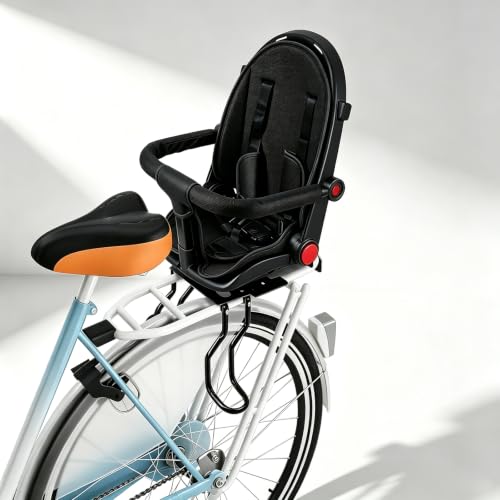
Rear Child Bike Seat Review Summary
The Rear Child Bike Seat makes sense for parents who want a straightforward back-mounted child seat with comfort features built in and a clear safety-first pitch from the listing.
It is aimed at kids ages 2 to 5 and up to 60 lbs, so it fits a fairly specific stage of family riding rather than being a universal buy.
Its strongest selling point is the combination of a supportive backrest, sponge armrests, padded cushion, 3-point buckle belt, and thickened foot pedals.
That mix suggests a seat designed to keep a child positioned comfortably while reducing the common annoyances that make bike-seat rides feel unstable or fussy.
The tradeoff is installation.
The listing is explicit that it uses screws and that all fasteners should be checked before every ride because vibration can loosen them over time.
That is not a dealbreaker, but it does mean this seat is best for buyers who are comfortable with a more hands-on mount and who will actually inspect hardware regularly.
Review Scorecard
| Category | Score | Buyer-focused rationale |
|---|---|---|
| Safety design | 8/10 | 3-point buckle, back support, and foot pedals all point toward a restraint-focused setup. |
| Comfort | 8/10 | Padded cushion, sponge armrests, and breathable mesh backrest are strong comfort cues. |
| Installation simplicity | 5/10 | Split design helps, but screw-based mounting and repeated tightening add upkeep. |
| Fit versatility | 7/10 | The listing says it fits all bicycle rear frames, but rear rack compatibility still matters in practice. |
| Day-to-day usability | 7/10 | Lightweight build and easy storage help, yet the hardware check requirement adds friction. |
| Value for the right buyer | 8/10 | Feature set is sensible if you want a rear seat with comfort and safety basics in one package. |
Key Features and Specifications of Rear Child Bike Seat
This is a rear-mounted child bicycle seat for adult bikes, with the listing describing it as suitable for children ages 2 to 5 and up to 60 lbs.
It is designed for the rear frame area and is presented as compatible with bicycle rear frames, including adult bicycle rear seats with storage racks.
The main structural details are practical rather than fancy:
- Split design with separate seat and foot pedal parts
- Screw-based installation using included screws
- Steel plate attachment and stainless steel buckles
- Wide supportive backrest
- Soft sponge armrests
- Padded cushion
- 3-point buckle seat belt
- Thickened foot pedals to reduce slipping
- Breathable mesh backrest material
- Lightweight build for carrying and storage
The listing also includes a specific maintenance warning: riders should fully tighten all screws during installation and inspect them before every ride because vibration may loosen fasteners over time.
That warning matters because it tells you the product is not meant to be a one-and-done mount-and-forget accessory.
From a buyer perspective, the feature set points to a seat that prioritizes predictable positioning over luxury.
The comfort materials are there, but the product is still clearly a utility item for regular family cycling rather than a premium padded touring seat.
Pros and Cons of Rear Child Bike Seat
Pros
- Comfort-oriented design with backrest, armrests, and cushion all included
- 3-point buckle belt adds a clear restraint layer
- Thickened foot pedals help keep feet positioned and reduce slipping
- Breathable mesh backrest should be more practical than a fully solid hot-back design
- Lightweight and easy to store compared with bulkier child-carrying setups
- Clear age and weight guidance makes the intended use case obvious
Cons
- Screw-based installation will not appeal to buyers who want a fast clip-on solution
- Regular hardware checks are required, which adds maintenance burden
- Rear rack and frame compatibility still matter, even if the listing uses broad compatibility language
- Limited flexibility because the seat is clearly built for a specific age and weight range
- No truly premium cues in the listing, so buyers looking for higher-end adjustability may want to look elsewhere
The biggest pros and cons are connected.
The same product that feels reassuringly structured also asks more of the parent during setup and upkeep.
If you value stability and are willing to maintain the mount, that is reasonable.
If you want convenience first, this is probably not your best match.
Who Should Buy Rear Child Bike Seat?
This seat is a fit for parents or caregivers who already know they want a rear-mounted bicycle seat for a young child and prefer a simple, structured design.
It suits families with kids in the 2-to-5 age range who are within the stated 60 lb limit and who will use the bike seat often enough to justify a more permanent installation.
It also makes sense if your priority is keeping a child supported and seated in a more controlled way.
The backrest, belt, armrests, and foot pedals together suggest a product meant to reduce wobble and wandering during rides.
You should probably skip it if you want:
- A quick-release seat you can swap between bikes easily
- A setup that needs minimal maintenance
- A more adjustable child-carrying system for growing kids
- A product for older or heavier children outside the stated range
In short, this is for practical family cyclists, not casual buyers looking for the simplest possible install.
Rear Child Bike Seat Safety and Ride Practicality
Mounting and Fastener Care
The listing puts unusual emphasis on tightening screws and checking them before every ride.
That is a useful signal rather than a red flag by itself: the seat is telling you exactly where ownership friction will come from.
If you are the type of buyer who already inspects bike accessories, this is manageable.
If not, the upkeep could become annoying fast.
Child Positioning and Support
The seat’s safety story is built around keeping a child seated, restrained, and feet-positioned.
The 3-point buckle handles upper-body containment, while the foot pedals and backrest help keep legs and posture in check.
That is a sensible layout for a rear seat because wandering feet and slumped posture are the common problems that turn rides into a constant correction exercise.
Comfort on Short Family Rides
The padded cushion, sponge armrests, and breathable mesh backrest all point toward comfort during shorter local rides, park loops, and everyday errands.
Nothing in the listing suggests a luxury ride experience, but the material choices are practical and age-appropriate.
For a child in the right size range, that matters more than decorative extras.
Frame and Storage-Rack Considerations
The product is aimed at adult bicycle rear seats with storage racks, so fit depends on the bike you already own.
Broad compatibility language is helpful, but on-bike accessories always benefit from a careful check of rack geometry, frame space, and how much room remains around the rider.
Buyers should treat the fit claims as a starting point, not a final guarantee.
Alternatives to Rear Child Bike Seat
If you want a different style of rear-mounted child seat, look at the Thule Yepp Nexxt Maxi, which is widely known for a more polished premium design approach.
If you want a common budget-minded comparison point, search for the Bell Cocoon 300, a familiar child bike seat line many parents use as a reference.
For a rack-style alternative with a different fit philosophy, consider the Topeak child bike seat search results, which may surface models with other mounting or comfort tradeoffs.
There is also a reason to compare this product against a rear rack child bike seat more broadly.
The right alternative depends less on brand loyalty and more on whether you want faster installation, better adjustability, or a more compact rear-mount profile.
Is Rear Child Bike Seat Worth It?
Yes, if you want a rear-mounted child seat for a young rider and you are comfortable with screw-based installation and routine hardware checks. The feature set is sensible, the safety and comfort cues are coherent, and the age/weight limits are clear enough to narrow the buy to the right family use case.
It is less compelling if convenience is your top priority or if you want a seat you can install and forget.
For the right bike, the right child size, and a parent willing to maintain the mount, this is a practical buy.
For everyone else, a more convenient alternative is likely the better choice.