The right backpacking tent can make a major difference on the trail. A good shelter balances low weight with dependable weather protection, useful interior space, and a setup you can manage when tired or conditions turn rough.
We’ve gathered 10 camping tents for backpacking in different sizes, seasons, and price ranges so you can narrow your choices based on trip length, sleeping capacity, climate, and pack weight.
Best 10 Camping Tents for Backpacking Picks for 2026
Trail-Ready Classic

- Freestanding aluminum frame
- Seam-taped three-season construction
- 30 sq. ft. interior with vestibule
Best For: Two-person backpacking and easy campsite setup
Solo Loadout Pick

- 2.97-pound minimum trail weight
- PU 5000 waterproof coating
- Side vestibule and mesh ventilation
Best For: Solo backpackers wanting compact weather protection
Comfortable Two-Door Option

- Two doors and dual vestibules
- 3000 mm waterproof protection
- Mesh walls and ceiling vents
Best For: Two-person trips needing access and gear storage
Roomy Value Shelter
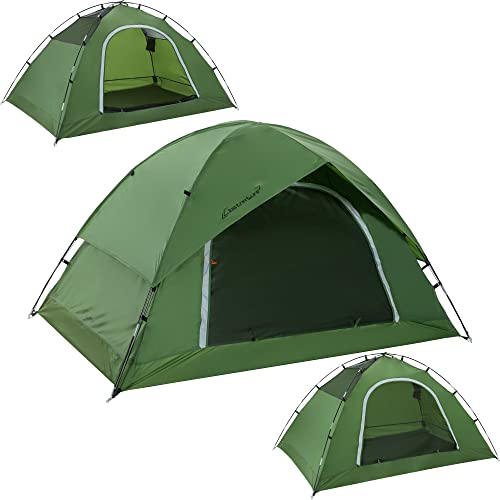
- Roomy two-person interior
- Freestanding setup in under five minutes
- PU 2000 coating and rainfly
Best For: Two-person camping where space matters more than low weight
Fast-Setup 2-Person Pick
Forceatt Waterproof Backpacking Tent

- Three-minute setup with aluminum poles
- Two doors and two vestibules
- PU 3000mm waterproof rating
Best For: Two-person trips needing quick setup and wet-weather coverage
Solo Lightweight Pick
Night Cat Compact Backpacking Tent

- Approximately one-minute clip setup
- 4.4-pound packed weight
- PU 3000 rainproof fabric and taped seams
Best For: Solo hikers prioritizing compact carry and rapid pitching
Value 2-Person Pick
BISINNA Lightweight Backpacking Tent

- Two doors with large mesh sections
- Aluminum poles and freestanding design
- PU 2000mm three-season rainfly
Best For: Two-person campers seeking room and versatile included gear
Four-Season Lightweight Pick
OneTigris Stella 2-Person Tent

- 4.8-pound 20D nylon design
- 3,000mm waterproof rating
- Freestanding setup in about three minutes
Best For: Backpackers wanting a compact two-person, four-season shelter
Versatile Three-Season Value
Clostnature 2-Person Backpacking Tent

- 4.5-pound minimum trail weight
- PU 5,000mm waterproof coating
- Two doors and two vestibules
Best For: Two-person trips needing storage, access, and weather protection
Solo Backpacking Budget Pick

- 4.4-pound compact package
- PU 3,000mm rainproof fabric
- Sets up in about one to two minutes
Best For: Solo hikers and scouts prioritizing portability and quick setup
Trail-Ready Classic – Kelty Grand Mesa 2
For shoppers comparing camping tents for backpacking, the Kelty Grand Mesa 2 stands out as a straightforward, freestanding shelter for two. Its aluminum frame, seam-taped construction, and included vestibule make it practical for three-season trips where easy pitching and dependable weather protection matter.
Best For: Two-person backpacking trips and campers who prioritize simple setup and a freestanding design.
Pros:
- Freestanding aluminum pole design can be moved after pitching.
- Quick Corners, color-coded clips, and fly attachments simplify setup.
- Seam-taped 68D polyester floor and rainfly provide waterproof protection.
- Includes a protected vestibule and Shark Mouth carry bag.
Cons:
- At about 4 pounds 7 ounces, it is not the lightest option for long-distance trips.
- One door may be less convenient for two occupants than a dual-door layout.
The Grand Mesa 2 is a balanced choice for backpackers who want reliable three-season features without a complicated pitch. Its weight favors comfort and ease of use over ultralight packing.
Solo Loadout Pick – Clostnature 1-Person
Among camping tents for backpacking, this Clostnature solo model is designed for hikers who want a compact shelter with useful weather protection. It combines a low minimum trail weight, aluminum poles, a mesh interior, and a side vestibule for gear storage.
Best For: Solo backpackers seeking a portable three-season tent with a relatively low trail weight.
Pros:
- Minimum trail weight is listed at 2.97 pounds and the packed size is compact.
- PU 5000-coated rainfly and bathtub floor support wet-weather use.
- Freestanding design and two aluminum poles allow quick solo setup.
- Mesh walls, a D-shaped door, and side vestibule add ventilation and storage.
Cons:
- Total weight is about 4 pounds, so it is not an ultralight shelter by strict backpacking standards.
- The one-person layout provides less interior flexibility than two-person models.
This tent makes sense for solo trips where portability and weather resistance are more important than maximum weight savings. Its included repair kit and one-year workmanship guarantee add practical reassurance.
Comfortable Two-Door Option – Night Cat 2-Person
The Night Cat 2-Person is a practical option for camping tents for backpacking when two occupants want easier access and dedicated gear storage. It offers dual D-shaped doors, dual vestibules, aluminum poles, and a full-coverage rainfly in a package weighing about 4.4 pounds.
Best For: Backpacking partners who value two doors, two vestibules, and strong ventilation.
Pros:
- Two doors make entry and exit more convenient for occupants.
- Dual vestibules provide extra storage for packs and footwear.
- Seam-taped construction and a waterproof floor are rated up to 3000 mm.
- Full mesh walls and ceiling vents help reduce condensation.
Cons:
- At approximately 4.4 pounds, it may be heavier than minimalist two-person shelters.
- Its three-season design is not presented as a winter or four-season tent.
With 31.24 square feet of floor area and a 55.2-inch floor width, the Night Cat emphasizes shared comfort and livability. It is a particularly useful fit for warm-weather trips where airflow and access matter.
Roomy Value Shelter – Clostnature 2-Person
For buyers comparing camping tents for backpacking, this Clostnature 2-person tent favors room and straightforward setup over minimum weight. Its freestanding dome design, dual-layer door, rainfly, and compact storage sack make it a versatile choice for casual backpacking and camping.
Best For: Two-person campers who want extra room, simple pitching, and a budget-friendly feature set.
Pros:
- Provides a roomy 7’3" by 4’11" sleeping area for two adults.
- Freestanding X-pole design can be relocated without fully disassembling.
- Factory-sealed seams, PU 2000 coating, and rainfly support wet-weather use.
- Mesh panels and a double-layer door help with ventilation.
Cons:
- At 5.29 pounds, it is the heaviest listed option for backpacking.
- Its PU 2000 waterproof rating is lower than the solo Clostnature model’s PU 5000 rating.
- The supplied specifications list only four stakes, which may limit setup flexibility.
This model is best viewed as a roomy, easy-to-pitch shelter for shorter backpacking trips, car camping, or hikers willing to carry additional weight. It offers useful comfort features without requiring a complicated setup.
Fast-Setup 2-Person Pick – Forceatt Waterproof Backpacking Tent
For hikers seeking camping tents for backpacking, the Forceatt is a practical two-person option with a quick setup, aluminum poles, two doors, and two vestibules. Its PU 3000mm waterproof rating, welded floor, and full-coverage rainfly are designed for wet conditions, while mesh panels and ceiling vents help manage airflow.
Best For: Two-person backpacking trips where fast pitching, vestibule space, and stronger rain protection matter.
Pros:
- Quick approximately three-minute setup with aluminum poles.
- Two D-shaped doors and two vestibules provide convenient access and gear storage.
- PU 3000mm waterproofing, welded floor, and full-coverage rainfly offer solid wet-weather protection.
- Mesh window and two ceiling vents improve ventilation.
Cons:
- At 5.5 pounds, it is heavier than the lightest backpacking shelters.
- The listed 43.3-inch height limits room to sit upright.
The Forceatt stands out for balancing quick setup and two-person livability with robust rain protection. Its 5.5-pound packed weight is worth considering if comfort and weather coverage take priority over minimizing every ounce.
Solo Lightweight Pick – Night Cat Compact Backpacking Tent
Among camping tents for backpacking, the Night Cat focuses on solo convenience: its clip-based design can be assembled in about one minute, and the packed size is compact enough for hiking or motorcycle camping. The 2-kilogram shelter uses PU 3000 rainproof fabrics, taped seams, a vestibule, and mesh ventilation.
Best For: Solo backpackers who prioritize low weight, compact packing, and very fast setup.
Pros:
- Clip attachment system enables approximately one-minute setup.
- At 4.4 pounds, it is the lightest listed option.
- PU 3000 fabrics and taped seams are designed for heavy rain protection.
- Mesh door and roof window support airflow while helping keep bugs out.
Cons:
- The compact interior is primarily suited to one adult, with room for one child if needed.
- It uses fiberglass poles rather than the aluminum poles found on the other listed options.
- It has one door, which provides less entry flexibility than two-door designs.
The Night Cat is the most straightforward choice for solo trips where packability and setup speed are key. Its single-person layout and fiberglass pole system make it less compelling for couples or shoppers seeking a more spacious, premium-feeling shelter.
Value 2-Person Pick – BISINNA Lightweight Backpacking Tent
The BISINNA is a value-oriented choice among camping tents for backpacking, offering a two-person double-layer design, aluminum poles, two doors, and a spacious layout. Its PU 2000mm rainfly, mesh construction, wind ropes, and included aluminum stakes make it suited to three-season hiking, camping, and bikepacking.
Best For: Couples or two-person campers wanting a roomy, versatile tent with aluminum poles at a budget-conscious weight.
Pros:
- Two doors and large mesh sections provide access and ventilation.
- Lightweight aluminum poles support a freestanding design.
- Double-layer construction and PU 2000mm rainfly provide three-season coverage.
- Includes a carry bag, flysheet, poles, ropes, and aluminum stakes.
Cons:
- The stated setup time is up to 10 minutes, slower than the other listed tents.
- Its minimum trail weight is listed as 6 pounds, making it the heaviest option here.
- PU 2000mm waterproofing is lower than the 3000mm ratings of the other two tents.
The BISINNA makes sense when interior room and useful included hardware matter more than ultralight packing. It offers a well-rounded two-person feature set, but backpackers counting ounces may prefer the lighter Night Cat or the quicker Forceatt.
Four-Season Lightweight Pick – OneTigris Stella 2-Person Tent
For shoppers comparing camping tents for backpacking, the OneTigris Stella stands out with a 4.8-pound packed weight, a 3,000mm waterproof rating, and a freestanding design that sets up in about three minutes. Its removable blackout outer tent adds flexibility for different conditions.
Best For: Backpackers and campers who want a compact two-person shelter with four-season features and straightforward setup.
Pros:
- Lightweight 20D nylon construction weighs 4.8 pounds.
- 3,000mm waterproof rating and silicone-coated fabric help protect against wet weather.
- Mesh inner tent promotes airflow, while crossing poles support quick setup.
- Includes poles, 10 stakes, guylines, and a storage bag.
Cons:
- At 4.8 pounds, it is not the lightest option for minimalist backpacking.
- The listed vestibule area is relatively limited.
The Stella is a practical middle ground for hikers who value weather resistance and easy pitching more than ultralight weight. Its two-person interior and compact 21.7-by-6.3-inch package make it suitable for a range of camping and hiking trips.
Versatile Three-Season Value – Clostnature 2-Person Backpacking Tent
The Clostnature two-person tent is a strong value-oriented choice among camping tents for backpacking, combining a 4.5-pound minimum trail weight with a PU 5,000mm waterproof coating. Its freestanding design, two doors, and two vestibules make it convenient for shared trips.
Best For: Two-person backpacking, bikepacking, and camping trips where low weight, storage space, and easy access matter.
Pros:
- Minimum trail weight is listed at 4.5 pounds, with a compact 16.5-by-5.9-by-5.9-inch packed size.
- PU 5,000mm coating and factory-sealed seams provide substantial water resistance.
- Two doors and two vestibules improve entry and gear storage.
- Includes aluminum poles, 14 stakes, guylines, and a pole repair kit.
Cons:
- It is a three-season tent rather than a four-season model.
- The total listed weight is 5.29 pounds, higher than its minimum trail weight.
- The supplied care instructions specify dry cleaning only.
With generous access and vestibule space, the Clostnature is especially practical for two campers sharing equipment. It offers useful weather protection and a reassuring one-year material and workmanship guarantee without straying far from backpacking-friendly weight.
Solo Backpacking Budget Pick – Night Cat One-Person Tent
For solo hikers seeking camping tents for backpacking, the Night Cat offers a compact 4.4-pound package with a one- to two-person capacity. Its single-layer design uses PU 3,000mm rainproof fabric, taped seams, and a setup time of roughly one to two minutes.
Best For: Solo backpackers, scouts, cyclists, and motorcyclists who prioritize compact packing and fast setup.
Pros:
- Compact 16.5-by-4.7-by-4.7-inch packed size and 4.4-pound weight suit mobile trips.
- PU 3,000mm fabric and enhanced waterproof seam tape help handle heavy rain.
- Mesh door and roof window support ventilation while helping keep bugs out.
- Protected fiberglass poles are designed to make assembly more comfortable.
Cons:
- The single-layer, one-door design provides less separation and access than larger two-door tents.
- Fiberglass poles are less suited to shoppers specifically seeking aluminum pole construction.
- The interior is best suited to one adult, with only limited capacity for an adult and child.
The Night Cat is a sensible lightweight shelter for solo trips where fast pitching and a small packed size are priorities. Its ventilation features and rainproof construction add practicality, while the included two-year manufacturer warranty is a useful extra.
How We Picked the Best Camping Tents for Backpacking
We focused on the factors that matter most when a tent has to be carried between campsites: packed weight, portability, weather resistance, livable space, setup design, and overall versatility. The selection includes compact one- and two-person shelters as well as larger options for couples, small groups, or hikers who want extra room.
We also considered useful trail details such as aluminum poles, vestibule space, waterproof ratings, ventilation, single- versus double-layer construction, and whether the design suits three-season or more demanding conditions. Product specifications can vary by size, so check the exact model and capacity before ordering.
Quick Comparison
| Best For | What to Prioritize | Typical Choice |
|---|---|---|
| Solo backpackers | Minimal packed weight and compact footprint | One-person or convertible one-to-two-person tent |
| Two hikers | Interior width, vestibule storage, and ventilation | Two-person backpacking tent |
| Three-season trips | Rain protection, airflow, and easy setup | Lightweight double-layer shelter |
| Windy or colder trips | Strong poles, secure staking, and coverage | Four-season or reinforced design |
| Budget buyers | Core weather protection and usable durability | Simple lightweight tent with aluminum poles |
Key Buying Factors for Camping Tents for Backpacking
Weight and Packed Size
Every ounce matters over long distances. Compare the complete packed weight, including poles, stakes, rainfly, and storage bags—not just the advertised minimum weight. A slightly roomier tent may be worthwhile for shorter hikes, while ultralight hikers should prioritize the smallest practical shelter.
Capacity and Interior Space
A labeled two-person tent usually fits two sleeping pads closely, with limited room for gear. Solo hikers often choose a two-person model for comfort, while two adults should look for adequate shoulder width and at least one vestibule. Consider peak height and floor dimensions, not capacity alone.
Weather Protection
Waterproof fabric, taped seams, a full-coverage rainfly, and a bathtub-style floor improve performance in wet conditions. A higher waterproof rating can add confidence during heavy rain, but pitching the tent correctly and choosing protected campsites remain essential.
Season Rating and Ventilation
Most backpacking tents are designed for three-season use. Four-season models offer stronger protection against wind, cold, and snow but may weigh more and provide less ventilation. Look for mesh panels, adjustable vents, and a rainfly design that allows airflow in warm weather.
Setup and Durability
Easy-clip systems and color-coded poles can save time at camp. Aluminum poles generally provide a useful balance of strength and weight. Before a major trip, practice setup at home and inspect pole joints, zippers, seams, and included stakes.
Who Should Buy Which Camping Tents for Backpacking?
Solo thru-hikers should choose the lightest shelter that still provides enough weather protection and sleeping space. Couples should prioritize a genuine two-person layout, vestibule storage, and ventilation rather than focusing only on minimum weight. Budget-conscious campers can select a straightforward three-season tent with a proven waterproof design and easy setup. Hikers facing exposed, windy, or colder routes should consider a sturdier four-season option and verify its snow and wind capabilities before departure.